The Causes of Christmas Day Disappointment

Many of us feel underwhelmed, let down, or downright disappointed on or after Christmas. Why is that?
Many of us feel underwhelmed, let down, or downright disappointed on or after Christmas. Why is that? | Source

What Is Christmas Day Letdown?

For some people, the frenzy leading up to Christmas Day results in feelings of disappointment when the big occasion finally arrives. Perhaps our expectations are so high that we’ve set ourselves up for a letdown. Does this sound familiar? According to psychologists, this phenomenon is actually fairly common.

Does your mental picture of the holiday include your children behaving well and loving and appreciating each gift you carefully selected for them? Does your vision feature your family in a picture-perfect gathering around a festive meal worthy of a Norman Rockwell painting? Do you place great value on receiving a meaningful gift that your significant other spent hours researching and selecting? In reality, our families and partners don’t always live up to our imagined expectations, and in practice, holiday celebrations aren’t always the idealized gatherings we build them up to be.

When I first got married, my early Christmas experiences with my in-laws disappointed me. It took me a few years to realize they weren’t going to celebrate the holiday in the same ways that my family did. Once I accepted that and let myself go with the flow, I began to enjoy their style of Christmas just fine.

Is it our unrealistic expectations that lead us to feel let down on Christmas? Or is it just the realization that the festive season is coming to an end? What do you think leads to this phenomenon of Christmas Day disappointment?

Friends Share Their Experiences With Christmas Letdown

After experiencing holiday letdown myself and learning how common it is, I wanted to find out why others felt this way. I decided to reach out to my friends and ask them about their thoughts on the matter. Here’s what they said:

  • “I don’t think Christmas is ever as magical when you are an adult as it was when you were a child. You can get a bit of that magic back if you spend Christmas with young children, but an adults-only Christmas is always going to be less exciting. That’s what I think.” —Stazjia
  • “After all the hype, it’s very easy to feel let down.” —Kayjay
  • “When my children were young, I was let down that I would spend so much time on their presents and preparing for Christmas only to find that all the excitement was over so soon. And then all the cooking would begin. It’s too much work. Now I just enjoy the day—I’m very relaxed. I just do my best and try to make the day as easy as possible. This took a long time to realize. Some good things come with age.” —Lucia
  • “My mother-in-law always feels down after Christmas. I’m not quite sure what she expects from her five kids, their spouses, and her grandkids. I think it’s just her personality.” —CatJB
  • “We’ve always had a low-key Christmas. This year we’re spending it with another family. I can’t help wondering what to expect.” —Valmnz
  • “It’s pretty much always anticlimactic for everyone in some way or another. It’s better to put in the effort without getting attached to outcomes.” —DarcieFrench
  • “Hubby and I went years without giving each other gifts—after the tornado, we had a rough time getting back on our feet. Still, Christmas was never a letdown. It was what it was. My only letdown this year will be if my siblings do not find it in their hearts to get past the animosity and sibling rivalry and mend the fence. All I really want for Christmas is peace in my family.” —Sgolis
  • “It’s easy to romanticize Christmases, especially those in the past. It is worth making the effort to relax and “let it be” to have a better day, as you say!” —Kimbesa

Can’t Have the Christmas You Want Anymore?

For some people with chronic illness or a disability, it’s much harder to participate in the December activities that they used to enjoy and take for granted. Perhaps the decorating is just too difficult now. Maybe they need to ask for a ride to attend family holiday gatherings.

For many, it can be a financial issue. When the budget is already tight, spending lavishly on gifts and activities just isn’t possible. They have to look for free events, create homemade gifts, shop second-hand, and otherwise scale back on Christmas expectations.

As people get older, they find it a struggle to put up a Christmas tree and other decorations. Getting gifts for family and friends is a challenge when living on a Social Security budget. If they no longer drive, participation in holiday activities and entertainment can be limited.

Why do you feel disappointed during or after Christmas?

  • 10% I feel sad that the joyful season is over.
  • 10% I feel tired and worn out from all the work involved in creating a happy holiday.
  • 77% I feel let down because it didn’t turn out the way I wanted (people, gifts, activities, etc.).
  • 3% I don’t like the aftermath of Christmas (un-decorating, returning gifts, paying bills).

370 people have voted in this poll.

This content is accurate and true to the best of the author’s knowledge and is not meant to substitute for formal and individualized advice from a qualified professional.

© 2019 Virginia Allain

What Was Christmas Like in the 1940s?

Skiing in the 1940s.
Skiing in the 1940s. | Source

Christmas in the ’40s

Have you ever wondered what your parents or grandparents experienced at Christmas time in the 1940s? I started focusing on this holiday while researching my parent’s World War II years. Only part of the decade was wartime; after that, the military men came home.

Christmas in the 1940s was quite different from Christmas during the Great Depression. I’ve been combing through Newspapers.com, which I subscribe to, to access digitized newspapers from this era. I also draw from some of my family stories of the time. Join me in learning more about this fascinating decade.

Boots was a popular comic strip in the 1940s. This one has a Christmas theme and shows a boy in a cowboy outfit with a gun (popular with kids at the time).
Boots was a popular comic strip in the 1940s. This one has a Christmas theme and shows a boy in a cowboy outfit with a gun (popular with kids at the time). | Source

What Toys Did Children Want?

It’s fun reading the letters to Santa that were printed in the newspapers between 1940 and 1949. The store advertisements also give you a good idea about what products were popular then.

Many of the requested toys in the newspaper letters were gender-specific. The boys asked for marbles, toy dump trucks, scooters, bicycles, toy trains, toy farm sets, and footballs. A 7-year-old asked for a BB gun, while a 12-year-old requested a 22 rifle. Girls asked for dolls, doll buggies, rocking chairs, and play dishes. In general, children asked for coloring books, crayons, fruit, and nuts. Tinker Toys were a popular plaything of that time and continued to be a favorite for decades.

Pearl Harbor and Christmas 1941

On December 7th, 1941, the U.S. fleet was attacked at Pearl Harbor. This launched the country into war with Japan. My aunt was a child then and remembers hearing the adults talking about the attack and listening to radio announcements on the news. She was so frightened by what was happening that she gathered her kittens and crawled under the bed to hide.

She was too young to realize that the Japanese fighter planes would not be bombing Kansas, where she lived. Both adults and children must have had a tense Christmas that year as the United States prepared for war.

My aunt and her kitten.
My aunt and her kitten. | Source

Christmas for the Soldiers in Far Away Places

The troops in faraway places could not come home for Christmas. Even travel within the United States was difficult as trains were needed to transport troops and war supplies, so it was not easy for a soldier on leave to travel to see his family.

The military tried to make Christmas Day festive for the troops by providing a turkey dinner and the usual holiday trimmings. However, this was not always possible for soldiers in the middle of combat zones.

The USO brought some performers and movie stars to put on a show for the troops in some areas. Bob Hope traveled to entertain the soldiers each Christmas, and you can see videos of that on YouTube.

Residents around the country often invited soldiers from local training sites to join them for their holiday feasts. Despite these efforts, it must have been a lonely time for the young men far away from their families.

If you possibly can, please bring our daddy home for Christmas.— Letter to Santa from a child

My Mother’s Experience of the Holidays During the War

My mother was eager to finish high school so she could contribute to the war effort. After training, she took a job at Boeing Aircraft in Wichita, Kansas. This meant renting a room in a boarding house, walking many blocks to catch the bus to the plant, learning new jobs there, working shift work, and being far away from her family. Sometimes, she was able to take a bus to see the family on a weekend.

She saved what she could from her paycheck as she planned to marry her sweetie once the war ended. He also was saving up for them to get a good start.

She did get some gifts for the family and her bus ticket to be with them for Christmas. After all these years, she doesn’t remember the gifts, but she treasures the special time she spent with her parents and younger sister.

The following photos are of my grandmother’s WWII experience.

This advertisement was from printed on page 32 of The Daily Tribune in Wisconsin Rapids, Wisconsin, on Monday, Dec 24th, 1945.
This advertisement was from printed on page 32 of The Daily Tribune in Wisconsin Rapids, Wisconsin, on Monday, Dec 24th, 1945. | Source

Gail Lee McGhee worked at Boeing in Wichita during the war years. This was her work uniform.
This is one of the boarding houses where my mother stayed while working at Boeing.
This is a photo signed by the co-workers on my mother's crew at Boeing.
Portrait of Gail Lee McGhee—1940s
This is a ration booklet from World War II. Some foods were limited as they were needed for the troops and also for refugees who were starving overseas.
Gail Lee McGhee worked at Boeing in Wichita during the war years. This was her work uniform.
Gail Lee McGhee worked at Boeing in Wichita during the war years. This was her work uniform. | Source

Popular Christmas Songs in the 1940s

  • Dean Martin: “Jingle Bells”
  • Gene Autry: “Up on the House Top”
  • Andrews Sisters & Guy Lombardo Orchestra: “Christmas Island “(1946)
  • Lena Horne: “What Are You Doing New Year’s Eve?”
  • Gene Autry: “Here Comes Santa Claus”
  • Frank Sinatra: “Mistletoe and Holly”
  • Gene Autry: “If It Doesn’t Snow on Christmas”
  • Gene Autry: “Freddie the Little Fir Tree”
  • Dean Martin: “Blue Christmas”
  • Louis Armstrong and Velma Middleton: “Baby, It’s Cold Outside”
  • The Dispoto Sisters: “Whistling ‘Neath the Mistletoe”
A 1940s radio where the family heard news and listened to the President give updates on the progress of the war.

The following photos are from the WWII museum in Wolfboro, New Hampshire, that depict what the holidays would have looked like during the 1940s.

A 1940s kitchen on display at the WWII museum in Wolfboro, New Hampshire.
A 1940s living room at the WWII museum.
Here's how families entertained themselves in the 1940s. At Christmas time, they would gather around the piano to sing carols.
Here’s how families entertained themselves in the 1940s. At Christmas time, they would gather around the piano to sing carols. | Source

Christmas Movies in the 1940s

Most of us can name the big 1940s films that featured a Christmas theme (Holiday Inn, It’s a Wonderful Life, and Miracle on 34th Street). These get replayed every December, and it’s fun to watch the old favorites again with such stars as Jimmy Stewart, Bing Crosby, Fred Astaire, and Ginger Rogers. Families did not have televisions, but many did go to the movie theaters regularly.

Here are some lesser-known 1940s Christmas titles you can seek out:

This content is accurate and true to the best of the author’s knowledge and is not meant to substitute for formal and individualized advice from a qualified professional.

© 2019 Virginia Allain

What Was Christmas Like in the 1930s?

Christmas Calendar for December 1930

from the Ellsworth Reporter newspaper,  Ellsworth, Kansas 11 Dec 1930, Thu  •  Page 14
from the Ellsworth Reporter newspaper, Ellsworth, Kansas 11 Dec 1930, Thu • Page 14 | Source

What Was Christmas Like in the Great Depression of 1930 – 1939?

In the year 1930, the worst of the Great Depression was still to come. Christmas was still a merry time for those who still had jobs and homes and hope. Many were worrying about the bad economic news but tried not to let their children know that hard times were ahead.

As the decade progressed, more families lost their incomes or had to take reduced wages. Families sometimes took in boarders to help cover the mortgage. Bread lines started to appear in cities and people lost their homes to the bank.

With such hard times, Christmas became a struggle to “be of good cheer.” The government under FDR’s New Deal created work programs to get people back to work.

Hundreds of people line up for the free Christmas dinner at the New York Municipal Lodging House during the Great Depression December 25, 1931.
Hundreds of people line up for the free Christmas dinner at the New York Municipal Lodging House during the Great Depression December 25, 1931. | Source

At the Grocery Store –

You would see barrels of nuts out front, inside you would see hard candy, fruit cakes just 50 cents a pound, mince pies, cranberry sauce in cans, and plum pudding.

Popular Toys of the 1930s and Other Gifts

Clipped from the Ellsworth Reporter  Ellsworth, Kansas 11 Dec 1930, Thu  •  Page 15
Clipped from the Ellsworth Reporter Ellsworth, Kansas 11 Dec 1930, Thu • Page 15 | Source

Gift Ideas for Children and the Whole Family

  • For boys and girls there were bicycles, air rifles, velocipeds, pop guns, coaster wagons, doll buggies, scooter, aeroplanes, pedal cards, train sets, Kiddie Kars, drums, ice skates, toy automobiles, swings, sleds, doll houses, boxing gloves, toy tractors, footballs and basketballs, toy trucks.
  • The family might wish for pool tables, backgammon sets and board games.
  • Gifts for the home might be electrical appliances like waffle irons, toasters, percolators (coffee makers), heaters, irons, sandwich toasters, and lamps.
  • Under the category of practical gifts, the ads suggested casserole baking dishes, teapots, waffle batter jugs, Pyrex glass ovenware, aluminum and enamel roasters and Wagner cast aluminum ware. Other gifts for mom might include decorated cake covers, decorated breadboards, French drip coffee pots, scissors and shears, carving sets.
  • Additional ideas were bird cages with a stand, decorated heat-proof china, auto robes and shawls.
  • For dad, there were flashlights, safety razors, pocket knives, guns and rifles, tool sets, hunting and fishing gear, auto tools, carpenter tools, lanterns and Coleman lamps.
Newspapers printed children's letters to Santa. Sometimes a kindly person would read these and get some of the gifts for the children.  This is fromThe Belleville Telescope  Belleville, Kansas 18 Dec 1930, Thu  •  Page 1
Newspapers printed children’s letters to Santa. Sometimes a kindly person would read these and get some of the gifts for the children. This is fromThe Belleville Telescope Belleville, Kansas 18 Dec 1930, Thu • Page 1 | Source

It was interesting that almost all the children mentioned

wanting candy and nuts after they told about the toys they wanted. Some asked for practical things like a dress or a coat. Many asked for something for a younger sibling too.

Special Foods for the Holiday

Sally remembers her mother’s story of that time, “we popped corn in a skillet with a lid, on a woodburning stove. We had to shake the skillet to make sure the popcorn didn’t burn.”

They made pumpkin pie from home-grown pumpkins. You cut them into sections and scrape out the seeds, then bake them until soft in the oven. After cutting off the skin, the pumpkin was mashed up and spices added and cream to go into the homemade pie crust. If there was no pumpkin, the pie could be made from sweet potatoes with the same cinnamon, nutmeg, and cloves seasoning. You could hardly tell the difference.

Hot chocolate was made in a pan on the stove from cocoa powder, sugar, and milk. There was no instant hot chocolate in those days.

Cookies from that time included molasses cookies, sugar cookies, and oatmeal raisin cookies. “Great grandmother loved oatmeal raisin cookies. She always boiled the raisins before folding then in so they would be moist and not chewy.” Fudge, divinity, and taffy were popular too. Making taffy and pulling it to harden could even be a party with friends.

People Mailed Christmas Cards in the 1930s

Advertisement from the Ellsworth Reporter - Kansas 11 Dec 1930, Thu  •  Page 14.  You could even get your name printed on them for that price. The price of a first-class stamp was 2 cents but later in the decade, it went up to 3 cents.
Advertisement from the Ellsworth Reporter – Kansas 11 Dec 1930, Thu • Page 14. You could even get your name printed on them for that price. The price of a first-class stamp was 2 cents but later in the decade, it went up to 3 cents. | Source

Christmas Activities

The newspaper featured news items about school programs for the holiday or church gatherings and parties. There was caroling, family dinners on Christmas Day, and other traditional holiday activities.

Source

Decorating for Christmas During the Great Depression

Memories of Long Ago Christmas Decorations

  • My mother remembers, “We had little money when I was very young so we made paper chains and popcorn strings with cranberries between a few bits of popcorn. We cut out cardboard stars and pasted the silver foil from chewing gum onto them.”
  • Susan tells that her dad would go to the woods and cut down a small pine tree to bring home for their holiday tree. Nancy’s grandmother remembered cutting holly branches in the wood. They put them in a bucket of water on the porch, then brought them inside at Christmas to tie red ribbon on the swags.
  • Lisa’s father showed the children how to make paper chains without using glue. You cut an L on each end and fold them together with the end tabs on the inside. You could use construction paper if you had it or cut the strips from magazine pages. They saved the chains to use again next year and kept adding to them so they were really long.

Thrifty Gifts for a Depression Era Christmas

As the Depression years dragged on, many workers were laid off, businesses closed down, and money was tight. The government provided some jobs in different programs to get people back to work, but there weren’t enough of those for everyone.

So people economized, and lived by the slogan “make do or do without.” At Christmas, they would make gifts with whatever they could manage. These needed to be things that involved labor rather than money. You could unravel an old sweater to use the wool for knitting a pair of socks or make mittens. Scavenging some wood meant you could hand-carve a wooden toys. An old orange crate combined with some baby buggy wheels from a broken carriage could be turned into a go-cart.

Banks Encouraged People to Save a Little Each Week for Next Christmas

https://www.newspapers.com/article/evening-eagle-1932-christmas-savings-clu/187079339/

All the banks advertised in January for people to start a Christmas savings account and make a weekly deposit. These were called Christmas Savings Clubs and the money was returned to the member in December to shop for Christmas gifts.

I’ll be adding more on this page about the later part of the 1930s when families were more financially strained.

This content is accurate and true to the best of the author’s knowledge and is not meant to substitute for formal and individualized advice from a qualified professional.

© 2019 Virginia Allain

What Was Christmas Like in the 1920s?

By Virginia Allain 

    I love Christmas and history, so I’m sharing what I learn about Christmas and its customs as they’ve changed over the decades and centuries.

    Christmas at the Keech house in Santa Ana.
    Christmas at the Keech house in Santa Ana. | Source

    The Merry Twenties

    Looking back 100-plus years ago, life changed a lot for Americans after the turn of the century. By the 1920s, World War I was over, and those in the military had returned home. The Spanish influenza epidemic had also ended. During this decade, more people lived in towns and cities than ever before. The economy was booming, life seemed good, fashion was changing, and many new conveniences were being developed.

    There were also changes regarding the celebration of Christmas. Using newspaper clippings from the era, let’s explore what Christmas time was like in 1920s America.

    What was Christmas like in the 1920s?
    What was Christmas like in the 1920s? | Source

    Holiday Activities With Family

    In the 1920s, many families gathered for a big Christmas meal and to exchange gifts. The main feature would likely have been a roast goose or turkey. Fat hens and ducks were also popular in holiday meals. In the past, revelers would travel “over the river and through the woods” by horse-drawn sleigh or buggy. By the 1920s, however, they traveled to grandma’s house by motorcar or train.

    What Gifts Were Popular With Children?

    Not surprisingly, letters to Santa in the newspaper asked for many traditional toys. Little girls wanted baby dolls, buggies, and stoves. In contrast, little boys asked for cowboy suits, tricycles, and BB guns.

    There were also new toys in the 1920s, such as little red wagons, yo-yos, pedal cars that you could ride in, Tinker-Toys, and electric trains that ran on batteries or electricity. Sometimes, children dreamed big and asked Santa for a pony for Christmas.

    What Gifts Were Popular With Adults?

    With electricity in many people’s homes, demand grew for more sophisticated household aids. Mothers hoped for this new decade’s electric irons, toasters, vacuum cleaners, and other wonders. Men’s gifts were often practical—socks, hats, handkerchiefs, house slippers, robes, and pocket knives were common choices.

    Sleds were popular Christmas gifts in the 1920s and had been for decades.
    Sleds were popular Christmas gifts in the 1920s and had been for decades. | Source
    Children could open an account to save their pennies for next Christmas.
    Children could open an account to save their pennies for next Christmas. | Source

    Technological Advances of the 1920s

    Think back to a time when there were no televisions or computers. Many of the things that we take for granted were not available in the 1920s, but some new technologies were indicative of huge steps forward (i.e., telephones and electricity). It was also a time when women won the right to vote and began to take jobs outside the home.

    “The electrical toy is a sign and symbol of what it means for a child to live in this wonderful age. He climbs on a stool to speak thru the telephone to someone he knows is blocks and blocks away from his own home. He puts his busy finger on a little button and floods a room with light or rings an unseen bell; he watches the maid put a plug in the electric socket and move an iron apparently free from fire over the laundry or toast bread in a similar way on the table and perform other feats simple enough to him. He runs to get into a carriage which moves of itself, and when he sees by chance a streetcar drawn by horses he nearly collapses with surprise.” —The Wichita Beacon Page 34, (December 19, 1920)

    A homemaker in 1924 would be thrilled to get this for Christmas.
    A homemaker in 1924 would be thrilled to get this for Christmas. | Source

    What Did Moms Want for Christmas?

    The advertisements were very tempting. Only $1 down, and all sorts of extras were included.

    “Think what a Christmas gift the Hoosier will make, a present that will take all the drudgery out of kitchen work—a gift that a busy woman will appreciate all year round. The Hoosier Kitchen Cabinet is in reality the product of the modern spirit of American women. They refuse to be slaves to their kitchens—they demand the kind of freedom the Hoosier gives. The Hoosier saves miles of steps, gives more hours for rest and recreation; eliminates all drudgery!

    “We are showing a full line of Hoosiers—various sizes and models. When you pay your one dollar enrollment fee, you get a fine 10-piece cutlery set, a 14-piece glassware set, a genuine Hoosier Kitchen Table or a new Hoosier Stepladder stool—ABSOLUTELY FREE!

    “The balance may be paid a little at a time. Included with every Hoosier Beauty is a splendid 14-piece set of crystal glassware—spice jars, coffee jar, tea jar, salt boat and air-tight containers for bulk foods, such as beans, hominy, crackers, etc. A wonderful extra feature!

    “Each member of the Club gets a 10-piece cutlery set free with the Hoosier Beauty! Genuine Hoosier Kitchen Table FREE! It has a beautiful white porcelain top and a spacious, easy-sliding drawer, and is finished all over in heavy white enamel.

    “The Hoosier Kitchen Cabinet has dozens of exclusive features—all the finest and newest labor-saving devices. Come in and examine it.” —Hoosier Kitchen Cabinet Ad (1924)

    Did You Know?

    During the 1920s, fire chiefs recommended that everyone light their trees with electrical lights instead of candles to lower the risk of accidental fires.

    Community Activities and Good Deeds

    Civic organizations and charities delivered food baskets to the poor in many communities. Groups like Rotary, the Lions Club, and the Salvation Army worked together to make sure shut-ins and families who had fallen on hard times would have food.

    Towns also held events for children a day or two before Christmas. In many communities, there would be a ceremonial lighting of the community Christmas tree and some entertainment. Santa Claus—or sometimes several Santas—handed out candy and nuts to hundreds of children. Women’s clubs and other organizations also helped organize and support these large events.

    Helping Overseas

    In Europe, many countries had to rebuild after the war. Their economies and infrastructures suffered a lot of destruction. There were food shortages. Appeals in newspapers asked Americans to help out by donating money, clothing, and food.

    Postal employees are working 12 to 15 hours a day so people in other towns may have their Christmas presents on time. Huge piles of packages stand in the post office waiting for delivery. Although the weary clerks are getting dark circles around their eyes, they have not forgotten that they are Emporia’s Santas, and that Santa never falls down on the job.— “The Emporia Gazette” (December 22, 1923)

    Remembering the Veterans at Christmas Time

    Wounded veterans from the First World War were remembered at Christmas. The American Legion took them gifts at hospitals in the early 1920s and later on to veterans’ homes. Besides serious injuries like loss of a limb or blindness, many suffered from “shell shock,” which is now known as PTSD. In 1920, there were 20,000 veterans hospitalized from illness or wounds across the country.

    In 1924, in one county in New York state, each received a Christmas stocking with a crossword puzzle book, cigarettes, and other items. Crossword puzzles were a big craze in the 1920s. Will Rogers, the famous humorist, said, “We may lose the next war, but we’ll sure win the next puzzle contest.” At this time, smoking was quite common before it was known to cause cancer.

    Did You Know?

    In the 1920s, families with a piano would gather around it to sing Christmas carols. New sheet music for popular tunes (i.e., jazz, show tunes, and dance music) were popular gifts. Some families also had gramophones to play records on.

    This content is accurate and true to the best of the author’s knowledge and is not meant to substitute for formal and individualized advice from a qualified professional.

    © 2020 Virginia Allain
    What Was Christmas Like in 1900?

    what-was-christmas-like-in-1900
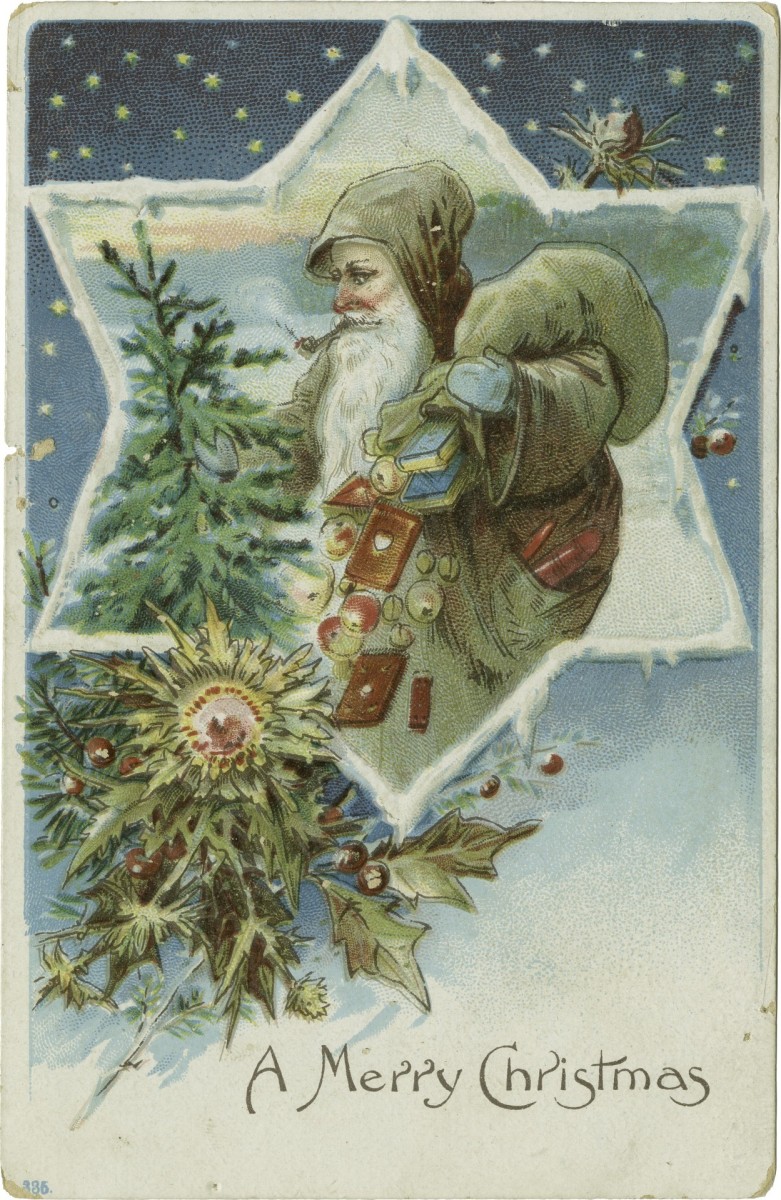
    Credit: Pixabay – A Vintage Santa Early Christmas Card

    By Virginia Allain (originally on Hubpages in 2023)

    Looking Back at Christmas in the Early 1900s

    It fascinates me to see the way people celebrated Christmas years ago. I searched old newspapers for 1900 to 1909 to see what it was like in that decade. Some customs were similar to how we celebrate today, but others seem quaint and old-fashioned.

    Read on to see what an American Christmas was like in the earliest part of the 1900s. It was a time when towns were growing as people moved away from farming and when time-saving inventions were making life easier.

    Christmas in 1900 America was a much simpler and less commercialized holiday than it is today. Some of the common activities included:

    • Church services: Attendance at church services was a central part of Christmas celebrations in 1900 America. Churches would hold special midnight mass services on Christmas Eve, which were well attended.
    • Decorations: Homes were decorated with evergreen trees, holly, and mistletoe. Candles and lanterns were also commonly used to add light and warmth to the festivities.
    • Gift giving: Gift giving was an important part of Christmas in 1900 America, but the gifts were usually simple and handmade, such as knitted scarves or hand-sewn quilts.
    • Caroling: Singing Christmas carols was a popular pastime during the holiday season. Children would go door to door, singing carols and spreading holiday cheer.
    • Family gatherings: Christmas was a time for families to come together, often traveling long distances to be with their loved ones. Large, festive meals were a central part of the celebrations, and people would often spend hours cooking and preparing food.
    • Games and activities: Children and adults alike would participate in games and activities such as sledding, ice skating, and snowball fights.
    Some snow, a wooden sled, and a hillside were fun for children in the early 1900s.

    Schools Held a Christmas Program

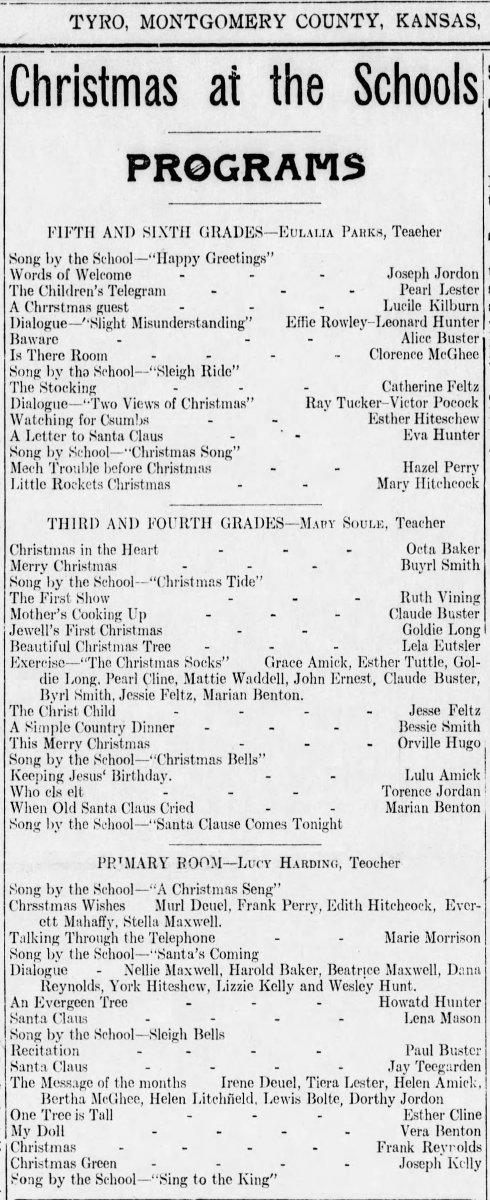
    Proud parents watched nervously as their children performed in the school Christmas program. This clipping intrigued me as it shows my grandmother, Ruth Vining, in the third/fourth-grade program. I’m not sure if it is a song or a recitation of a poem or essay.

    Also on the program is my grandfather, Clarence McGhee, performing in the fifth/sixth-grade program. My great-aunt, Bertha Mcghee, is in the primary group. No time or place was given in the 1909 article, but likely it was held the week before at the school.

    Christmas program at Tyro School 23 Dec 1909, Thu Tyro Telegram (Tyro, Kansas) Newspapers.com

    1909 Christmas program at Tyro, Kansas.
    1909 Christmas program at Tyro, Kansas.Newspapers.com

    Teddy Roosevelt Was President at That Time

    Roosevelt Family Kitchen

    A festive holiday meal was prepared for the Roosevelt family on this stove. Years ago, I toured this house and could imagine the family ready to sit down for Christmas dinner together.
    A festive holiday meal was prepared for the Roosevelt family on this stove. Years ago, I toured this house and could imagine the family ready to sit down for Christmas dinner together.Virginia Allain
    The view from the window showed the lawns going down to the sea.
    The view from the window showed the lawns going down to the sea.Virginia Allain

    A Silent Movie from 1909 – “A Trap for Santa Claus”

    Christmas Trees of That Time

    A turn-of-the-century Christmas tree refers to a Christmas tree from the late 19th to early 20th century, around the year 1900. During this time period, Christmas trees were typically decorated with handmade ornaments and festive lights, and were often displayed in the home.

    what-was-christmas-like-in-1910

    What Was Christmas Like in 1910?

    Vintage Christmas cards: Little child in bed with antique dolls

    Antique Toys on Free Vintage Christmas Cards

    christmas-100-years-ago

    What Was Christmas Like in the 1920s?

    Turn of the century Christmas trees were usually smaller in size compared to modern Christmas trees and often decorated with Victorian-style ornaments, such as glass balls, tinsel, candy canes, and paper chains. Some families would also create homemade ornaments from materials like fabric, paper, and natural elements like dried fruit and popcorn.

    Candles were commonly used as lights for the tree, providing a warm and inviting glow. However, this had a high risk of fire and families would often place the candles in secure holders or surround the tree with a protective barrier to prevent a disaster. The tree was often put up on Christmas Eve and the candles were only lit for a very short time for all to see.

    The Christmas tree was often the centerpiece of holiday celebrations and a symbol of the family’s festive spirit. Children would often gather around the tree to sing Christmas carols, exchange gifts, and enjoy sweet treats.

    Stringing Popcorn for the Christmas Tree

    what-was-christmas-like-in-1900
    Pixabay

    Make Your Own 1900’s Christmas Tree Decorations

    Popcorn Garlands – Pop the popcorn (don’t add any butter) and let it cool. Thread a needle with a long piece of white thread and tie a knot in one end. Use the needle to stick through the soft parts of the popped corn and push it to the end of the thread. Keep going until it is full. Tie a knot in that end to keep the popcorn on the thread. Drape the popcorn garland on the tree. After Christmas, put it outside on the bushes for the birds to eat.

    Children Made Gifts for the Family

    Children were encouraged to make a gift for their father, mother, sisters, and brothers. For father, they might make a penwiper from felt or chamois. This was in the era before ballpoint pens, so after dipping the pen in ink, it could be wiped to avoid drips.

    For a mother, one could crochet a small cover to slip over the end of the mother’s sewing scissors.

    A very happy little girl with her Christmas toys.
    A very happy little girl with her Christmas toys.Pixabay

    Gifts for Children

    Children hoped for a special toy under the Christmas tree. For some, it might be a knitted scarf from their mother and a hand-carved wooden horse figure from their father. If the family could afford it, the gifts available in stores were more elaborate.

    There were cloth-bodied dolls with painted china heads. A wooden rocking horse big enough to ride on made many children happy. Toy trains, a tricycle, and a doll carriage were popular gifts too.

    Looking in old newspapers like a 1901 Chicago Tribune, I found advertisements for a lovely selection of toys for little boys and girls.

    Overall, Christmas in 1900 America was a time for families to come together, celebrate their faith, and enjoy each other’s company. It was a much simpler and less commercialized holiday than it is today, but no less festive and joyful.

    This content is accurate and true to the best of the author’s knowledge and is not meant to substitute for formal and individualized advice from a qualified professional.

    © 2023 Virginia Allain

    Make a Victorian Fan Christmas Ornament

    Allain Christmas profile image

    Virginia Allain 

    Crafts are great for one-of-a-kind gifts or special decorations at Christmas time. You can make ornaments or other decorative items.

    I go all-out for Christmas decorating and even like to make my own decorations. | Source

    Try This Easy Christmas Craft

    If you love Victorian Christmas ornaments, here’s an easy one to make. It takes only a few minutes to create a Christmas fan from a small piece of taffeta ribbon. These look like the ornaments you see on holiday trees in prints from the 1880s.

    You’ll be amazed at the results even if you aren’t the least bit crafty. Hey, I made some of these myself, even though I must admit that I didn’t inherit my mother’s super-crafter genes.

    I combine them with some other simple Victorian touches on my Yule tree, like sparkly chandelier prisms and some lace potpourri sachets. If you like a themed tree, you can go the whole Victorian route for a real showstopper.

    Get out your ribbon, and measure out about 5 inches. Experiment with the size that suits you. I like my fans rather petite.
    Get out your ribbon, and measure out about 5 inches. Experiment with the size that suits you. I like my fans rather petite. | Source

    Supplies for This Easy-to-Make Fan

    • Scissors (regular sewing scissors or small embroidery scissors will work)
    • Ruler (optional)
    • Wide ribbon with lace edges or without the lace
    • Iron (optional)
    • Needle
    • Thread

    I’m guessing that you’ll have most of these around the house already. If you don’t have them, your local discount store, like Walmart or even a dollar store, will have them in stock.

    So, it’s time to get started. Here are examples using a variety of ribbons.

    A closer look at the Victorian fan ornament made from plaid ribbon.
    A fan ornament made from red lace-trimmed ribbon.
    A completed Victorian fan ornament hung on the tree.
    A completed Victorian fan ornament hung on the tree. | Source

    1. Cut the Ribbon

    You’ll need wide ribbon to make Victorian fan Christmas ornaments. Use a wide ribbon in any color or design that appeals to you. Colorful plaids were popular during the Victorian time. Preferably, the ribbon should have lace on both edges.

    I like taffeta or grosgrain ribbon. The ribbon needs some stiffness to it so it will stay pleated. Don’t use the ribbon with the wires in it.

    Cut the ribbon into pieces about five inches long.

    Victorian fan Christmas ornament

    2. Pleat the Ribbon

    Above is a ribbon left over from one of my Christmas packages. It would make a great Victorian fan ornament.

    1. Start folding each piece of ribbon into pleats.
    2. Make all the pleats the same width.
    3. For most ribbons, just pinch the fold with your fingers to make a sharp crease. You can also press it with an iron to set the creases. Make sure the iron isn’t too hot or it will melt certain types of ribbon.
    Pinch at the base of the fan and stitch it to hold in place.
    Pinch at the base of the fan and stitch it to hold in place. | Source

    3. Stitch the Base of the Fan

    Next, stitch the base of the fan where you pinched it together.

    1. Hold it at one side and let the other side fan out.
    2. Stitch it by hand, back and forth, to keep the base of the fan together. Use thread that matches the lace color. It won’t be visible then.
    3. Possibly you could glue it, but I’ve never tried that method.

    4. Add Embellishment to the Base of the Ornament—Bows or Miniature Roses

    1. Add a tiny bow if you want at the base of the fan, or just leave it plain.
    2. Hang the fan by looping thin gold thread through the top lace, or just use a metal ornament hook.
    3. Get tiny roses to decorate the base of the fan. They are usually available at discount stores like Walmart in the craft or sewing section.
    I hope you'll make some fan ornaments for your tree this year. It's fun to make your own decorations, and it makes your tree unique.
    I hope you’ll make some fan ornaments for your tree this year. It’s fun to make your own decorations, and it makes your tree unique. 

    Frugal Gift Wrapping Tips

    Allain Christmas profile image

    By Virginia Allain

    Source: Virginia Allain

    How Can You Save Money on Gift Wrapping?

    If you are frugal by nature or have to be thrifty to make the budget stretch, then spending money on fancy gift wrap doesn’t make sense. You can still have an attractive present without splurging big bucks on elaborate bows, decorated wrapping paper, and rolls of ribbon.

    Another reason to go frugal with your gift wrapping is to reduce the amount of waste we create. Most gift wrap gets ripped off, crumpled up, and tossed in a very short time. What a waste.

    I’ll show you options that you may not have discovered yet. These include creative and fun ways to give a gift some pizzazz without spending much. Saving on the outer part might let you spend more on the gift itself.

    Start the Tradition of a Santa Sack

    Get each child a Santa Sack and use it year-after-year. Make sure it is big enough to hold most of their gifts. Put their name on it. Put the gifts inside without any further wrapping.
    Get each child a Santa Sack and use it year-after-year. Make sure it is big enough to hold most of their gifts. Put their name on it. Put the gifts inside without any further wrapping. | Source

    A Santa Sack Will Last for Years

    The way these works is each child has their own Santa Sack. Embroider the name on each sack or have a tag on the drawstring with the name. On Christmas Eve, the children can place their Santa Sacks under the Christmas tree for the Jolly Old Elf to fill with gifts.

    Once the children go to bed, the parents fill the bags with unwrapped gifts (think of all the wrapping paper, ribbon, and bows that won’t be going into the trash). This custom also saves a lot of time for busy moms and dads.

    In the morning, the children take turns reaching into their own sack and pulling out a gift. This creates suspense as they wait their turn to find out what is hidden in the bag. After the gifts have all been discovered, store the sacks away for next year.

    Decorate Gift Packages with Old Christmas Cards

    Click thumbnail to view full-size

    Tip #1

    You can use old Christmas cards for gift tags too.

    Brown Paper Wrapping

    This isn't a new idea but it's worth reminding you of it. If you shop at a store that gives paper bags, save them to use for wrapping. Add decorative stickers or little drawings or simply let the ribbon say it all.
    This isn’t a new idea but it’s worth reminding you of it. If you shop at a store that gives paper bags, save them to use for wrapping. Add decorative stickers or little drawings or simply let the ribbon say it all. | Source

    Use Your Computer to Make Personalized Wrapping Paper

    You can print out personalized wrapping paper using your computer printer. Works for a small gift. Type any message you want, then copy and paste to fill the whole page.
    You can print out personalized wrapping paper using your computer printer. Works for a small gift. Type any message you want, then copy and paste to fill the whole page. | Source

    Cut strips of the wrapping paper and curl them with the edge of the scissors (the same way you curl ribbon). Gather the curly strips together and tape to the present.

    Tip #2

    Use remnants of yarn or rickrack for ribbon on a present.

    Pick Up Rolls of Ribbon and Lace at Yard Sales

    Usually I pay a quarter or maybe a little more if it's a large roll of ribbon. Gifts decorated with lace really look special. Often, I find vintage ribbon that's not the flimsy kind in the stores, but real woven ribbon.
    Usually I pay a quarter or maybe a little more if it’s a large roll of ribbon. Gifts decorated with lace really look special. Often, I find vintage ribbon that’s not the flimsy kind in the stores, but real woven ribbon. | Source

    Substitutes for Regular Wrapping Paper

    • Pages from magazines
    • Your kid’s artwork
    • A roll of wallpaper from Goodwill
    • Decorative paper shopping bags
    • Potato chip bag washed and turned inside out (they are silver inside)
    • Brown paper used as filler in Amazon shipping boxes
    • White newsprint paper (get the roll end from a newspaper printing place for a small fee)
    • Pictures from expired calendars
    • White freezer paper
    • Road maps
    Save this beautiful bow to use again. (photo by Virginia Allain)

    Tip #3

    Save the paper, ribbons, and bows from gifts you receive. They may need freshening up by pressing with an iron or reshaping the bow with your fingers. Use these to wrap gifts you are giving. Add accents like a sprig of evergreen or holly if you have those in your yard.

    Video Tutorial: Make Gift Bags from Newspaper

    Skip the Wrapping and Hide the Gift

    This is especially good for a large or odd-shaped gift. Put it somewhere that it won’t be seen. Put a teasing hint of the item in an envelope and a clue for the person to find it. There’s no use trying to wrap a child’s red wagon or some new golf clubs for the golfer in the family. Those are just too difficult, and it would waste a huge amount of paper. You can even make it complicated by hiding a series of clues, so they have to go from spot-to spot reading the clues to find the gift.

    A variation of this is useful when an ordered gift is late arriving. Print a picture from online or cut one out of a catalog. Enclose it in a holiday card with a message telling them about the delay of their gift. Make sure the envelope doesn’t get lost in the flurry of unwrapping. Place it on the Christmas tree or another secure place.

    Please share your tips for thrifty gift wrapping in the comments.

    Have a Little House on the Prairie Christmas

    Use the Theme of “Little House on the Prairie” for a Thrifty Christmas

    Christmas might be limited if finances are tight. Turn the bleak looking holiday into something special by celebrating it the pioneer way. Get the whole family involved to celebrate Christmas the Little House on the Prairie way. I’ll give you some tips on activities to do and gifts to make that will make the season special and fun for the whole family.

    The books can be borrowed from the public Library.

    Reading the Little House series of books by Laura Ingalls Wilder as a child took me to an earlier time. It was a time when life was not easy but the family persevered together to make a warm and happy home on the prairie or in the big woods. Our own family history had some parallels to the book series and my own grandmother actually lived in a sod house in Oklahoma when she was a little girl.

    Perhaps your family has a pioneer history and the children can learn about that as well during the time you are preparing for your Little House on the Prairie Christmas.

    My ancestors arrived in Kansas in a covered wagon similar to this one. They lived the life of pioneers and probably had a frugal Christmas just like the Ingalls family did in the Laura Ingalls Wilder stories.

    Read the Story to Prepare for the Holiday

    Even if the family is familiar with the stories, it sets the tone to re-read the chapter about Christmas. Have a family read-aloud session and then brainstorm how you can celebrate Christmas like Laura’s family did.

    The original series of Little House stories are available at all public libraries. Just ask the librarian for them. In more recent times, some of the stories have been adapted for younger readers with an easier reading level.

    Ma was busy all day long, cooking good things for Christmas.

    — Laura Ingalls Wilder

    Foods Made by Ma at Christmas in the Little House Stories

    • salt-rising bread and ‘Injun bread,’
    • Swedish crackers
    • a huge pan of baked beans with salt pork and molasses (recipe)
    • vinegar pies (check the video in the link for making these) and dried-apple pies
    • cookies

    Involve the kids in figuring out what to cook with what is at hand. Remind them that the Ingalls family couldn’t get into the car and go to the supermarket for groceries. They had to make do with what they had.

    Let them help with the measuring and stirring and other preparations.

    Learn More about Pioneer Christmas Times and Customs

    Search the internet using the keywords “pioneer Christmas” and you’ll find lots of activities and information. Here are a few samples from a search like that:

    For example, the kids can “churn” butter using a simple jar and some heavy cream. It takes a while of shaking the jar to get it to turn into butter.

    There Are Many Different Crafts That Children Can Make for Gifts

    Children love making things, so look for crafts that use supplies that you already have around the house. If your child has a doll, they can make doll clothes for the doll using material from outgrown or ragged/stained clothing. Work with one child making the doll clothes to give to a sibling for their doll as a Christmas gift.

    You could melt down some bits and pieces of candles, then let the children create a new candle by dipping a string into the wax. This requires adult supervision to see that no one gets burned on the hot wax.

    Use blocks of wood and simple paints to make miniature houses to place under the holiday tree. Spread some newspaper or plastic over the work area in case anyone spills or drips paint.

    Each child could make a book for a sibling. Use plain paper and cut out photos from magazines to paste on the paper. Then they write a story to accompany the pictures. If you don’t have glue, you can make some flour and water paste. Let them choose the pictures, create the storyline, hand letter it onto the pages, and they might need your help to staple or tie the pages into book form.

    Finding time to work with each child might be the hard part. Keeping the gifts secret adds extra suspense to the holiday gift exchange.

    My mom had such fond memories of her rag doll from her childhood, that she made one for each of her daughters and for the grandchildren too.

    Gail Lee Martin’s Prairie Doll Made of Rags

    My Mother’s Instructions for Making a Rag Doll

    Plan to make Christmas presents for each other. Help the children make a rag doll for a gift. See the link above for more detailed instructions for a prairie rag doll.

    To make one like this, first tear cotton fabric into strips (an old sheet would work).

    Take Time to Savor Everything!

    From the book, “One morning the whole world was delicately silvered. Every blade of grass was silvery and the path had a thin sheen…. When the sun came up, the whole prairie sparkled. Millions of tiny, tiny sparks of color Millions of tiny, tiny sparks of color blazed on the grasses.”

    Laura Ingalls Wilder

    Cook a Little House Recipe

    Here’s a Marvelous Source of Information

    Don’t miss a website called Little House on the Prairie which is chock-full of nostalgia about the stories and has recipes and crafts and family activities. You will find plenty to keep the family busy for the month of their Pioneer Christmas.

    If you have snow, make up a recipe of taffy (molasses and sugar made into a syrup) then drizzled on fresh snow to harden.

    Plan frugal activities like making gingerbread (no, not making gingerbread houses and not gingerbread men, just plain gingerbread). You can find the recipe for gingerbread in the Laura Ingalls Wilder stories or choose a gingerbread recipe from an online site.

    The Great Thing about Cooking with the Kids Is They Learn Life Skills While Having Fun

    You can cheat a little by getting a box mix from the store, but make sure that the children realize that on the prairie everything had to be made using ingredients you have on hand.

    Visit a Pioneer House

    Touring a vintage log cabin gets everyone in the pioneer mindset. They have a chance to see the simple interior and the small rooms and the lack of modern amenities like a bathroom or electricity.

    If you live close to any of the Little House historical sites or museums, plan an outing for the family. If there aren’t any near where you live, check for a pioneer museum or a log cabin that you could take the family to see.

    Pioneer Christmas Tree Decorations

    Decorate the Christmas tree with old-fashioned paper chains and foil-covered cardboard stars. Make popcorn and fresh cranberries into chains or make just plain popcorn chains. Make it fun to create the decorations with the whole family gathered around the table. (keep the TV turned off)

    AI creation by Virginia Allain – Making Paper Chains

    Any paper can be used to make a paper chain, it can even have words or pictures. Don’t go buy construction paper. The pioneers couldn’t do that. They would have used paper that they had on hand. Use pages out of a magazine or use sheets of junk mail cut into strips.

    Small yarn dolls make great ornaments for the Christmas tree.

    Let the Children Dress Up in Pioneer Outfits

    For girls, it can be a plain or flowered shirt, then a full skirt of Mom's will probably reach the floor on them. Cinch it with a belt or safety pins. For boys, plain slacks or jeans, make some pretend suspenders from belts.
    For girls, it can be a plain or flowered shirt, then a full skirt of Mom’s will probably reach the floor on them. Cinch it with a belt or safety pins. For boys, plain slacks or jeans, make some pretend suspenders from belts.

    Evening Activities

    Pioneer families entertained themselves on long winter nights by making music. Have a family songfest singing all the Christmas carols you know.

    They also read together by the fireside. Read from favorite Christmas stories, the Bible, or from the Little House books. My mother remembers that during her 1930s childhood in the Kansas Flint Hills, they would all gather around the table in the evening while her parents took turns reading stories aloud to their children by the light of an oil lamp.

    Share your ideas in the comments for a thrifty, pioneer Christmas…

    Remembering CJ

    My mother’s younger sister died this morning. It’s hard to believe that CJ (Carol Jean McGhee Garriott) is gone. Her vibrant personality and enthusiasm for life gave the family the feeling that she would be around for years and years. She had a pixie smile that led strangers to underestimate her sheer determination and strength of character. She usually got what she wanted.

    She was 88 and at the hospital for what was expected to be a simple operation to remove a kidney stone. Sadly, something went wrong. She is the last of my aunts and uncles, so that generation is gone on both sides of the family.

    Some Stories of CJ Over the Years